BEGINNER’S GUIDE · CLASSIC SUDOKU
How to Play Sudoku: A Beginner’s Guide
Learn the three rules, work through your first logical move, and know what to do when you get stuck.
Explore the guide
The three rules of SudokuMake your first move: check the row, column and boxUse notes to keep track of possibilitiesLook for the only place a number can goWhat to do when you get stuckThree common beginner mistakesQuick questions before your first gameContinue with one focused techniquePlay one easy puzzleSudoku is a logic puzzle played on a 9 × 9 grid. Fill the empty cells with the numbers 1 through 9 so that every row, every column and every 3 × 3 box contains each number exactly once. The numbers already printed in the grid stay where they are.
You do not need to add, subtract or calculate anything in classic Sudoku. The numbers are labels. Your job is to work out where each one belongs.
Open classic Sudoku →Choose Easy when starting a new puzzle, or read the example first.
The three rules of Sudoku
- Every row contains 1–9, with no repeats. A row runs across the grid.
- Every column contains 1–9, with no repeats. A column runs down the grid.
- Every 3 × 3 box contains 1–9, with no repeats. The thicker lines divide the grid into nine boxes.
All three rules apply to every cell at the same time. A number that fits its row may still be ruled out by its column or box.
Make your first move: check the row, column and box
Start with an empty cell in a row, column or box that already has plenty of numbers. There is no need to begin in the top-left corner or fill cells in order.
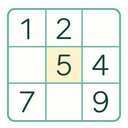
Look at the highlighted cell below. It sits in row 5, column 5: the fifth row from the top and the fifth column from the left.
- Check its row. Row 5 already contains 1, 2, 3, 4, 6 and 8. The missing numbers are 5, 7 and 9.
- Check its column. Column 5 already contains a 7, near the bottom. The highlighted cell cannot be another 7.
- Check its box. The middle 3 × 3 box already contains a 9, in its bottom-left cell. That rules out 9.
Only 5 remains. You can enter it without guessing. A cell with just one possible number is called a naked single.
For a complete deduction and a counterexample, read the naked singles guide.
Use notes to keep track of possibilities
When a cell has more than one possible number, write those possibilities as small notes, also called candidates. In Zen Sudoku, turn on Notes before choosing numbers to record candidates rather than final answers.
A note means “this number is still possible,” not “this is the answer.” Check the row, column and box before adding it. As you fill nearby cells, review the notes and remove possibilities that no longer fit.
You do not need to cover the whole board in notes immediately. Start with a small area where they help you compare options.
The notes and candidates guide shows how to calculate a complete set and update it after an entry.
Look for the only place a number can go
Sometimes a cell has several candidates, but one of those numbers has no other possible location in its row, column or box. That number must go there. This is called a hidden single.
The distinction is useful: a naked single is the only number for a cell; a hidden single is the only cell for a number within one row, column or box. For the second pattern, you must check the other empty cells in that group before making the move.
A candidate table in the hidden singles guide shows how to check every possible location.
What to do when you get stuck
Try a different part of the board. A move you cannot make yet may become clear after you fill another cell. Recheck rows, columns and boxes with only a few gaps, then review your notes.
If you use a hint in Zen Sudoku, first inspect the highlighted area. The hint lets you move from observation to reasoning, then reveal the answer if you choose. Take a moment to understand the elimination before filling the cell. Some positions need more advanced reasoning than the current hint can explain.
There is no need to beat the timer while learning. Aim to explain why each number belongs.
Three common beginner mistakes
- Checking only one rule. Always check the row, column and box.
- Treating a possible number as a certain answer. Two candidates mean the cell is unresolved. Use notes or look elsewhere.
- Keeping outdated notes. A newly placed number can eliminate a candidate from several nearby cells. Review them as you go.
Quick questions before your first game
Do diagonals have to contain 1–9?
No. Classic Sudoku only applies the rule to rows, columns and 3 × 3 boxes. Variants such as Sudoku X add other constraints.
Can a number appear more than once on the whole board?
Yes. Each number appears nine times in a completed classic grid: once in each row, column and box. Repeats are forbidden within a single group, not across the whole puzzle.
Is Killer Sudoku the same game?
Killer Sudoku keeps the row, column and box rules, then adds outlined cages with totals. The numbers in a cage must add up to its total and cannot repeat within that cage. Start with the Killer Sudoku rules when you are ready to try it.
Continue with one focused technique
Use notes when several digits remain. Look for a naked single when one cell has only one candidate, or a hidden single when a digit has only one location in a region. For sum cages, start with Killer combinations.
Play one easy puzzle
For your first game, use a simple loop: choose a promising area, check all three rules, enter a number only when you can justify it, and look again. Each confirmed number gives you more information for the next move.
Play Sudoku →Review the classic rules · Explore more Sudoku tips
Read next
Classic Sudoku Rules: Rows, Columns and BoxesSudoku Notes: Find and Update Candidate NumbersNaked Singles in Sudoku: One Cell, One CandidateHidden Singles in Sudoku: One Digit, One LocationAbout the examples
Written with AI assistance for Zen Sudoku. Classic candidate deductions and cage arithmetic are checked by automated validation. Figures are teaching examples; incomplete cage fragments are labelled. Language wording awaits editorial review.
Rules reference: Sudoku.com