Tips & Guides
Killer Sudoku Rules: Cages, Totals and No Repeats
Understand Killer Sudoku cages and totals, learn why combinations do not determine order, and apply the 45 rule with a careful example.
Explore the guide
Read the cage before doing arithmeticA combination is a set, not a placementWhen the 45 rule is validA small check before you playA useful first-game routineKiller Sudoku keeps the Classic row, column and 3 × 3 box rules, then adds cages outlined by dotted lines. The digits inside each cage must add to its printed total, and no digit may repeat within that cage.
Read the cage before doing arithmetic
The small total is a clue, not a value to enter into its top-left cell. A cage can cross box boundaries. Its no-repeat rule still applies to the entire cage, including cells that do not share a row, column or box. See the Classic constraints if those are new to you.
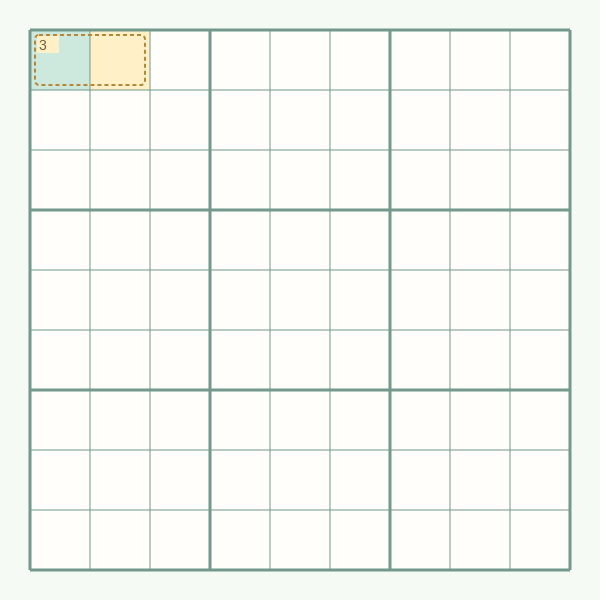
The two highlighted cells form a cage totaling 3. The only set of two different digits is {1, 2}. This does not tell you whether the left cell is 1 or 2. Row, column and box information must decide their order.
A combination is a set, not a placement
A two-cell cage totaling 4 allows {1, 3}, not {2, 2}. A total of 10 allows {1, 9}, {2, 8}, {3, 7} and {4, 6}. Swapping the digits within a pair does not create a new combination, but can create a different placement.
Use the cage combinations guide to eliminate sets with a worked example. Do not fill a whole cage just because its combination is unique.
When the 45 rule is valid
Each complete row, column or box totals 45 because it contains 1–9 once. If non-overlapping cages cover eight cells of a box and stay entirely inside that box, with totals 10, 12 and 18, the ninth cell is 45 − 10 − 12 − 18 = 5.
Check the boundaries first. If a counted cage extends outside the box, its full total cannot be subtracted as though it were all inside. Overlapping or partly counted regions also invalidate this shortcut.
A small check before you play
Two cells in the same cage total 16. What digit set is possible?
Show the reasoning
Only {7, 9}. The pair {8, 8} repeats a digit, and smaller starting digits would require a partner larger than 9. The order remains unresolved without position constraints.
A useful first-game routine
Find a small cage, list its distinct-digit combinations, compare each cell with its row, column and box, then record unresolved candidates as notes. Recalculate after a confirmed entry. A sum check never replaces the other rules.
Play Killer Sudoku →The diagram is a teaching fragment, not a complete uniquely solvable puzzle.
Read next
Classic Sudoku Rules: Rows, Columns and BoxesKiller Sudoku Combinations: From Cage Sums to PlacementsSudoku Notes: Find and Update Candidate NumbersAbout the examples
Written with AI assistance for Zen Sudoku. Classic candidate deductions and cage arithmetic are checked by automated validation. Figures are teaching examples; incomplete cage fragments are labelled. Language wording awaits editorial review.
Rules reference: Sudoku.com